Listen read aloud, 6 min — or as a conversation, 9 min
Write before You Reply
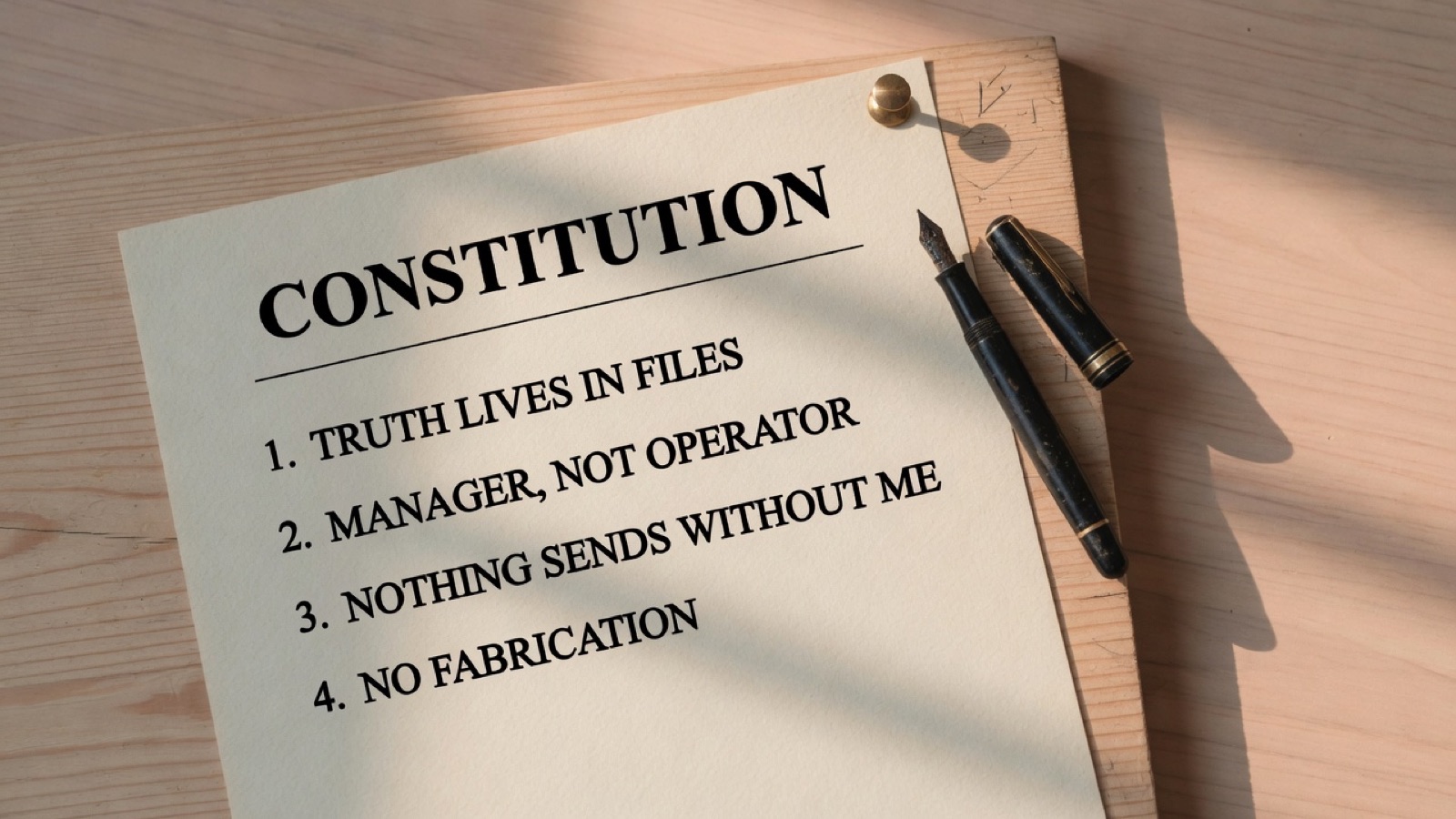
The first operating rule of the constitution is the one that makes everything else possible: whenever you tell the assistant a new fact, it writes it to the right file before it responds. Not after. Not “I’ll note that.” Before.
The reason is structural, not procedural. A conversation is the only place a language model naturally remembers anything, and a conversation ends. Every fact that stays in the transcript and never reaches a file is a fact the next session will not know. So the discipline is inverted from how people usually use an assistant: the reply is the by-product; the file edit is the work.
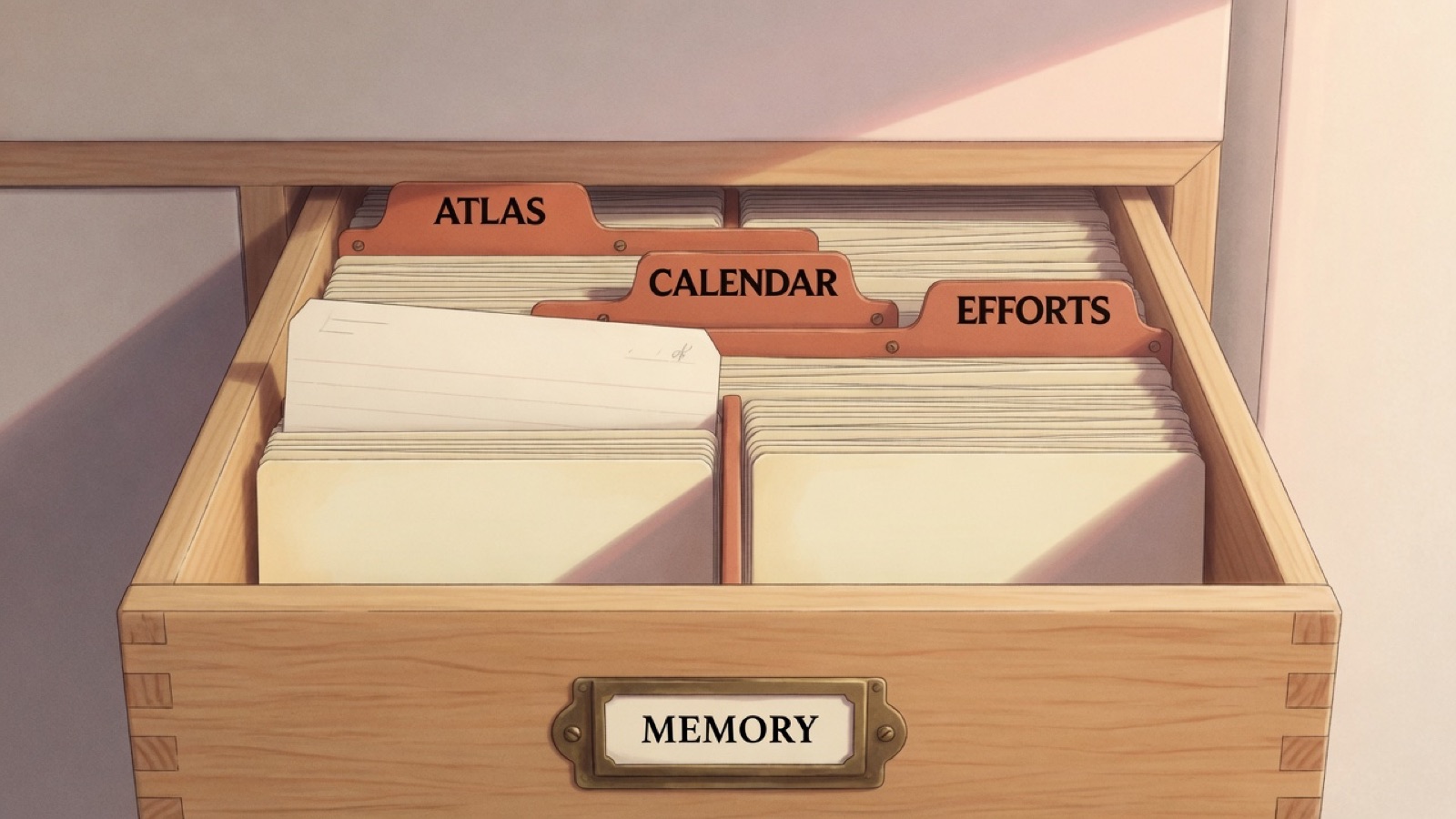
This is also why the system refuses vendor memory features. They are convenient and they are opaque — you cannot diff them, revert them, move them to another machine, or hand them to a different model. A folder of Markdown can do all four.
Trust Plus Audit Beats Gates Plus Approval
There are two ways to make an assistant that edits your knowledge base safe. You can gate every edit behind a confirmation — and within a week you are clicking “approve” without reading, which is worse than no gate. Or you can let it edit freely and make every edit auditable and reversible. The system chose the second, and wrote it down as one of its earliest decision records.
The bargain is full edit authority over the vault in exchange for four rails, every time:
- One git commit per meaningful edit, never batched, with a structured message:
cos: <path> — <one-line summary> (<source>). The commit log becomes a readable narrative of what the assistant learned and when. - A provenance comment in the file itself when the fact traces to a capture, an email, or a voice note:
<!-- src: inbox/2026-04-26-voice-3.md -->. Survives in plain text; invisible when rendered. - A curation-log line in the day’s note: file path, summary, source. One place to see everything that changed today.
- The brief surfaces the diff. The daily brief opens with “Atlas changes since last brief” — high-impact edits called out individually, low-impact ones summarised as a count with a link to the log. You never have to go looking for what changed; it is the first thing you read.
Wrong edits are one git revert away. A diff you cannot trace back to a source is itself a bug, and the fix is to re-run the edit through the proper flow — or, if the source genuinely cannot be cited, to recognise the edit was too speculative and ask first.
Read the Diffs for the First Month
git log over the vault is your window into how the assistant thinks. For the first few weeks, read it daily. You will find edits that are exactly right, edits that are slightly off, and — occasionally — an inference that should never have been recorded as fact. Each of the last two is a feedback-log entry. Trust arrives on evidence, and the evidence is the commit history.
Files and Tasks Divide the Work
A boundary worth writing down early: files are the source of truth and state; the task graph is the source of effort and intent. The activity signal for “is this venture moving?” keys off file modification times, never off task counts. A venture with lots of task churn but no note edits is still stale — tasks track work-to-do, not work-done. Conversely, a venture whose hub note was edited yesterday is fresh even with no open tasks. This keeps the assistant honest about the difference between touching the queue and moving the work.
Portability Is a Test, Not a Feature
The whole system must survive three moves: to a new machine, to a new model, and to a new person maintaining it. The test is simple — clone the repository somewhere else and start a session. If anything is missing, state leaked outside the vault. The usual suspects: a vendor memory store, a secret that was committed by accident (which should never happen — secrets live in the home directory, never the vault), or a script that hard-codes a path.
What This Costs
Honesty about the tradeoff, since the decision record carries it too: the assistant spends real effort on bookkeeping — a commit, a comment, and a log line for every fact. Sessions are a little slower and a little more verbose in their tool use. In exchange you get an assistant whose every belief has a receipt. For a system that runs your life, the trade is not close.
Hand this to your chief of staff. Plain Markdown: /guides/files-are-memory.md. Tell it: "Read this guide and tell me what in our system it would change."
Also for your Claude: whole-site index · bootstrap prompt · guide feed