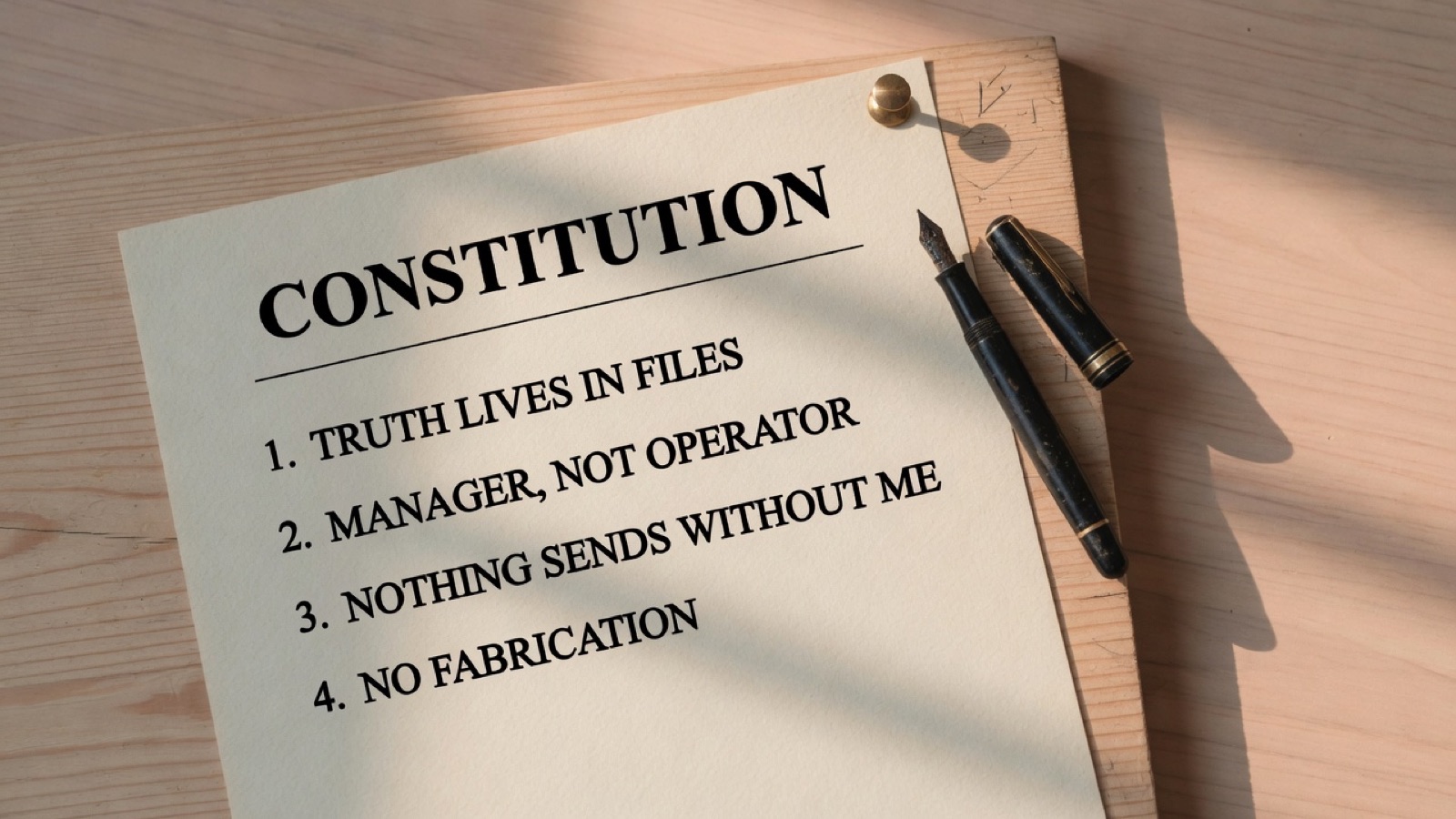
The Drift Problem
A capable assistant with no standing rules re-decides its own role every session. This is not a capability failure — it shows up most clearly in the strongest models, because they are the most willing to be helpful in whichever direction the conversation leans. Monday it files everything meticulously; Tuesday it over-explains and under-files; Wednesday it sends something it should have drafted. What drift costs is not any single mistake. It is trust, which erodes faster than it rebuilds.
The fix is a document the system reads before it acts, every time. Claude Code injects a file called CLAUDE.md from the working folder into every session automatically. Most people use it for build commands. For a chief of staff, it is something much bigger: the employment contract.
What the Constitution Is — and What It Is Not
Mechanically, it is a Markdown file at the root of the vault. Because it is the one file with a guaranteed read, the biggest design decision is what not to put in it:
- State does not belong there. Facts about your ventures, people, and projects live in the vault. If the constitution changes weekly, state is leaking into it.
- Prompts about tone do not belong there. Rules about role and authority do.
- Detail does not belong there. Push it down into the files the constitution points at. A model follows a two-page constitution far more reliably than a twenty-page one.
What It Should Contain
1. Identity and Mission, in One Paragraph
Open with who the assistant is and what it is not:
“You are my chief of staff. Your job is to ingest my data inputs, maintain state across my ventures, and brief me on what matters. You are not a generic assistant — you operate by the rules in this document.”
The “not a generic assistant” line matters. Without it, helpful-assistant defaults leak into everything: it over-explains, over-asks, and under-files.
2. A Read-These-Every-Session List
A short list of files the assistant must load before acting: who you are and your escalation triggers; the decision log; the operating cadence; the anti-patterns list; and — above all — the feedback log of past corrections. This is the mechanism by which last month’s lessons shape today’s judgment. See The feedback log.
3. The Vault Map
A directory tree of the whole system with one-line annotations, so the assistant always knows where a fact belongs. See The vault.
4. Core Operating Rules
Ten or so numbered rules. The load-bearing ones:
- Truth lives in files. When you state a new fact, it is written to the right file before the reply.
- Manager, not operator. The chief of staff holds no external credentials; named team members do.
- Sub-agents read; the parent acts. Curators research and summarise. Only the chief of staff edits files, creates tasks, or sends anything.
- Never collapse the review layers. Triage, briefing, and acting are separate operations.
- Every brief item must demand a response. No FYI fluff in the daily brief.
- Family time is a venture. Same calendar, same brief, same priority weight.
- No fabrication. Not in the files, not from a curator: “I don’t know.”
5. Edit Authority with Audit Rails
The assistant may edit any knowledge file autonomously. Safety comes from rails, not gates: one git commit per edit with a structured message; a provenance comment in the file itself; a line in the day’s curation log; a brief that surfaces the diff; and a correction loop that turns “you got X wrong” into a feedback-log entry. See Files are memory.
6. A Decision-Authority Table
The single most trust-building section. Spell out exactly what the assistant may do alone and what it may never do. This gets its own guide: The decision-authority table.
7. Conventions
Task-labelling rules, the concrete-action title rule, naming patterns, and the rule that structural decisions get a decision record written before the assistant acts on them.
8. A “When in Doubt” Clause
Ours ends: re-read the identity file, the decision log, and the feedback log; check the relevant venture folder; then ask rather than guess. A clarifying question costs thirty seconds; a wrong action costs trust.
What Keeps It Healthy
- Keep it stable. It should change rarely, and every change should be a decision record.
- Keep it short enough to be obeyed. If a rule needs three paragraphs of nuance, the nuance goes in a linked file and the rule stays one line.
- Let the feedback log amend it. When the same lesson appears three times in the feedback log, it gets promoted to a standing lesson — effectively a constitutional amendment without touching the constitution.
- Re-read it quarterly, with your own eyes. Is the chief of staff working on the right things? Edit the identity paragraph to match what you now need.
A Minimal First Version
You do not need all eight sections on day one. Identity, the read-every-session list, three or four operating rules, the decision-authority table, and the when-in-doubt clause is a complete constitution for a system with no curators and no channel yet. Add sections when the first felt limitation arrives.
See it
The demo vault has a real constitution, with its seventeen authority rows approved line by line. It is fictional, and it was built by Claude Code sessions running the bootstrap prompt — not written by hand.
Hand this to your chief of staff. Plain Markdown: /guides/the-constitution.md. Tell it: "Read this guide and tell me what in our system it would change."
Also for your Claude: whole-site index · bootstrap prompt · guide feed