Prerequisites
- Claude Code (CLI or desktop app) on a plan that supports agentic use. The guides are written for Claude but the design is model-agnostic: everything is plain files.
- git installed. If you know nothing about git, that's fine — the assistant drives it. You'll learn to read
git log, which is your window into how it thinks. - Optionally, Obsidian, for a pleasant human-side view of the vault. The system works without it.
- Optionally, beads (
bd) for the task graph. You can start with a plain tasks file and graduate later. - Sixty to ninety minutes of honest answers. The interview is the real work; the scaffolding is minutes.
The Bootstrap Prompt
Create an empty folder, open Claude Code in it, and paste this:
I want to build my own AI chief-of-staff system, modelled on the public
blueprint at https://www.chiefofstaff.io.

Start by fetching https://www.chiefofstaff.io/llms.txt, then read every guide in
the "Core concepts" track in order, using each guide's Markdown link. Skim
the titles of the other tracks so you know what exists; we'll return to them.

Then act as my guide, in this order:

1. INTERVIEW ME — properly. Don't stop at what I volunteer. Prompt me, area
   by area, the way a good chief of staff on day one would: my roles and
   ventures (companies, side projects, investments, family, health, home,
   money, relationships — personal areas count as ventures with equal
   standing); the people who recur across them; the tools I live in (email
   accounts, calendars, issue trackers, chat, banks); recurring commitments
   and deadlines; what I dread forgetting; and what a genuinely useful daily
   brief would contain for me. One cluster at a time. Keep going until
   you've heard nothing new for two rounds.

2. SCAFFOLD my version in this folder as a git repository:
   - CLAUDE.md — my constitution, adapted from the guide, with a
     decision-authority table I approve line by line.
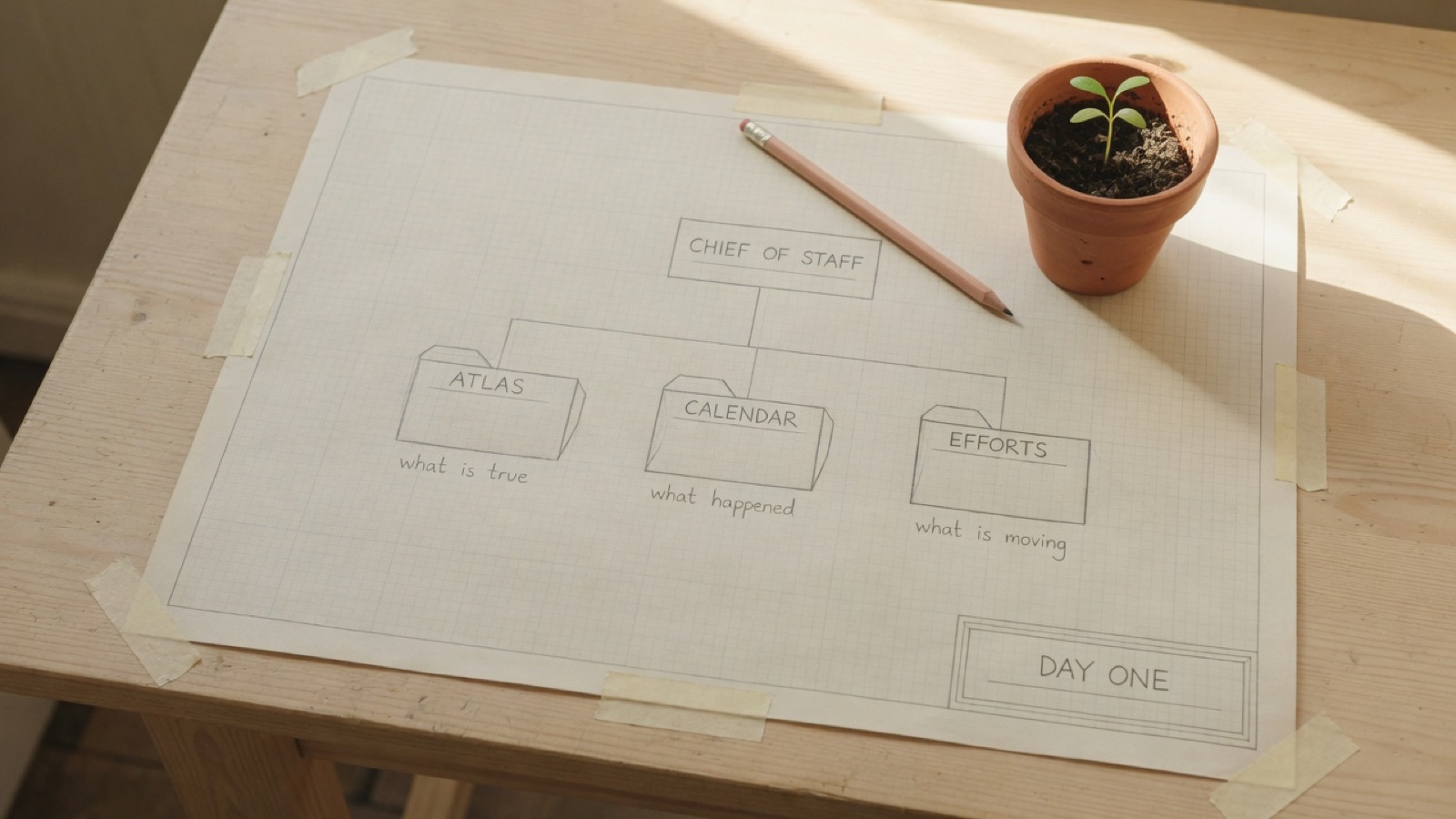
   - The Atlas / Calendar / Efforts vault: one venture folder per area of
     my life from the interview, each with a VENTURE.md; Atlas/people/ with
     one note per recurring person; Atlas/about-me.md from my answers.
   - Atlas/decisions.md seeded with an ADR for each structural choice we
     make today, each with a "Reverse if" condition.
   - Atlas/anti-patterns.md from the guide, trimmed to what applies to me.
   - Efforts/feedback.md, empty except for the entry template, plus a rule
     in CLAUDE.md that you read it at the start of every session.
   - Efforts/cadence.md with a daily-brief time and a weekly-review slot
     that I choose.
   - The task graph: beads (bd init) if installed, otherwise a simple
     interim tasks file — with the four cognitive-mode labels and the
     concrete-action title rule from the guide.
   - A /daily-brief command that, for now, builds the brief from vault
     contents alone.
   Commit each structural piece separately with a descriptive message.

3. KEEP what is structural (files as memory; one git commit per edit with
   provenance; manager-not-operator delegation; the feedback loop; ADR
   before action; every brief line demands a response) and ADAPT everything
   personal. Where the blueprint's choice doesn't fit my life, propose an
   alternative and record it as our own ADR.

4. DO NOT connect to any external account today — no email, calendar,
   trackers, or messaging. When I'm ready, we'll write a charter for a named
   curator first, per "The team" track, and grant the narrowest credentials
   that work.

5. WATCH FOR NEW GUIDES. Add a step to my weekly review that fetches
   https://www.chiefofstaff.io/guides.json, compares it with
   Efforts/cos-guides-seen.json, and surfaces anything new or updated as a
   short "New from chiefofstaff.io" section — one line per guide with a
   one-sentence take on whether it applies to us — so I can say "yes,
   implement that one." Some entries are addressed to me rather than to
   you — audience: "principal" — and are to be briefed in one line, never
   implemented. Record this as an ADR. Details:
   https://www.chiefofstaff.io/guides/watching-for-new-guides.md

6. CONTRIBUTE BACK. Add a second step to my weekly review: if we solved
   something this week that would generalise — a process, a correction, a
   rule that earned its place — name it in one line and ask whether I want
   it written up. If what we learned was about how I should work with you
   rather than how you work, it goes back as a practice piece instead:
   kind: "human", plus a stage. Nothing leaves this vault unless I say
   yes, and anything published is abstracted before it is drafted: no
   names, no numbers, no counterparties. When I say yes, register once at
   https://www.chiefofstaff.io/contribute and submit under my name; keep the
   token wherever we decided secrets live, which is never the vault.
   Record this as an ADR with a "Reverse if" like every other.
   Details: https://www.chiefofstaff.io/contribute.md

7. FINISH TODAY by generating my first daily brief from vault contents
   alone, and tell me the three things to capture next that would make
   tomorrow's brief better.

Work step by step. Confirm each structural decision with me before writing
it down as an ADR. If you're unsure where a fact belongs, ask — a clarifying
question costs thirty seconds; a wrong action costs trust. What Happens Next: The Stages
- Day one — a thin, correct system.
Vault scaffolded, constitution approved line by line, first crude brief generated from files alone. It will be thin. That's correct — everything that follows is added in response to a felt limitation, not in advance of one.
- Week one — the capture habit.
You dump voice notes, links, and ideas at one inbox. Triage turns them into tasks and notes. The brief starts reflecting your actual life. Read the diffs; correct every mistake and make it write the lesson down.
- Week two — the first curator.
Usually email or calendar, read-only, under a charter you approved and the narrowest credentials that work. The brief gains outside signal. (Hiring a curator.)
- Month one — the channel and the loop.
The brief reaches your phone. Voice notes flow back in. Every message you send gets an outcome and a receipt. Corrections accumulate; you notice the assistant stops making the mistakes you flagged. (Delivery track.)
- Month two and on — the review surface and the execution lane.
When typing dispositions starts to chafe, ask your chief of staff to build you a local review surface. When "research X and send me a report" starts piling up, give it an execution lane. Each is a guide here; each was built by the system for itself.
A day is enough, if you give it one. The weeks in that list describe how fast the habit settles, not how long the building takes.
Advice from the Scar Tissue
- Start smaller than feels impressive. Constitution, vault, feedback log, one command. Every curator, cron job, and tool in the reference system was added in response to a felt limitation, never in advance of one.
- Never let the assistant hold credentials it doesn't need today. The charter-first rule is annoying exactly once per tool, and pays forever.
- Correct it every single time, and make it write the lesson down. The feedback loop is the compounding asset. An uncorrected mistake is a mistake you've scheduled to recur.
- Read the diffs for the first month.
git logover the vault is your window into how the assistant thinks. Trust arrives on evidence. - Keep it portable. If a feature ties your system to one machine or one product, ask what breaks when you move. Plain files, plain git, plain CLIs.
- Make it prompt you, not just take dictation. The interview only works if the assistant pushes: "what about money? what about your parents? what do you dread forgetting?" If it stops at what you volunteer, say so — that is your first feedback-log entry.
Then Bring Your Questions Back to Your Own Chief of Staff
It has this site, it has your files, and helping you build itself out is exactly the kind of work it's for. Every guide here ends with a Markdown link you can hand it: "read this and tell me what in our system it would change." When it builds something the guides don't cover, it can register and contribute a guide under your name.
For your Claude. This page as Markdown · whole-site index · guides feed.
Read first: What a Chief-of-Staff System Is · The Constitution · The Vault