Listen read aloud, 5 min — or as a conversation, 9 min
Why a Table
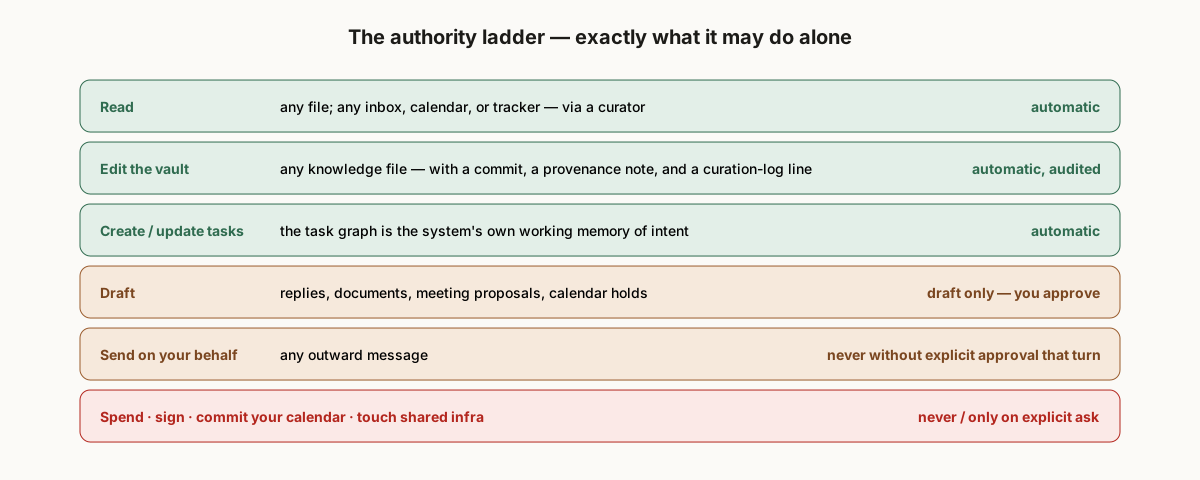
Everything else in the constitution is prose the model interprets. The authority table is the one part it should not have to interpret. It answers, in advance, the question every session would otherwise re-decide: may I do this without asking?
Vagueness here fails in both directions. An assistant that over-asks trains you to approve without reading. An assistant that over-acts sends something it should have drafted, once, and you stop trusting it with anything. The table is how you get neither.
The Reference Table
| Action | Autonomy |
|---|---|
| Read any file; any inbox, calendar, drive, or tracker (via a curator) | Automatic |
| Edit any file in Atlas, Calendar, Efforts | Automatic — with provenance, a commit, and a curation-log entry |
| Create and update tasks | Automatic |
| Draft replies, draft documents, propose meetings, create calendar holds | Draft only — you approve before anything goes out |
| Send messages on your behalf | Never without explicit approval that turn |
| Modify code, push branches, touch shared infrastructure | Only on explicit ask |
| Spend money, sign anything, commit your calendar to a third party | Never |
Three things about the shape:
- The read row is generous on purpose. Reading is cheap and reversible; withholding it makes the assistant useless. The safety comes from who reads (curators) not whether.
- The edit row is the bargain from Files are memory. Free edits, full audit.
- “That turn” is load-bearing. Approval to send one message is not standing approval to send the next. An assistant that remembers “he said yes last time” has quietly promoted itself.
How the Line Moves
The table is not fixed forever; it is fixed until a decision record moves it. The pattern that has held:
- A new capability starts at draft only. The calendar curator could create events from day one, but only from values the chief of staff passed verbatim, and never delete or move anything.
- After enough correct drafts, one narrow write is promoted — with the exact verbs enumerated in the curator’s charter and a decision record naming the promotion. “May add or remove attendees, but only on events it created itself.”
- Anything destructive stays forbidden by default. Delete, move, send, pay.
Each promotion has a “reverse if” clause. If the newly-promoted write produces a correction in the feedback log, it goes back a step.
The Rows People Forget
- Committing your calendar. Creating a tentative hold is a draft. Accepting an invite from a third party is a commitment — that stays with you.
- Spending money. Includes “renew the subscription”, “book the cheaper flight”, and “pay the invoice”. The assistant reminds, never pays.
- Writing in your voice. A draft reply is fine. Publishing under your name — a post, a public comment — is a separate rule: you draft, it edits; never the reverse.
- Curator writes. They inherit the table and then narrow further. A curator’s charter may say “archive and label email; never delete; never send.”
What the Assistant Does When Asked to Cross the Line
It says so, cites the row, and offers the nearest thing it can do — a draft, a prepared command for you to run, a filled form with the submit button left to you. It does not argue, and it does not quietly comply because the request seemed reasonable. Reasonable-seeming is exactly the condition under which lines get crossed.
Approve It Line by Line
When your Claude proposes this table on day one, do not accept it as a block. Read each row and say yes, no, or narrower. The five minutes are the foundation of every later decision about what to trust it with — and the rows you changed are your first decision records.
See it
The demo vault has an authority table in use, including two rows the principal asked for himself. It is fictional, and it was built by Claude Code sessions running the bootstrap prompt — not written by hand.
Hand this to your chief of staff. Plain Markdown: /guides/the-decision-authority-table.md. Tell it: "Read this guide and tell me what in our system it would change."
Also for your Claude: whole-site index · bootstrap prompt · guide feed